
Clevelands House can’t sit derelict forever.
Most people I talk to want the same thing: a revived resort village at Minett, with restaurants, services, and cleaned-up structures – as long as the rules we change to get there don’t come back to haunt Muskoka.
If you need the big-picture background on the Clevelands House development in Minett – what Phase 1 includes, how we got here, and the full timeline – start with our overview post: Clevelands House development in Minett: full plan, timeline and what’s happening now.
On November 25th, Township of Muskoka Lakes Council held a Special Planning Committee meeting for Phase 1 of the Clevelands House redevelopment. At that meeting, the Clevelands House wetland was centre of mind for anyone who had read the Environmental Impact Study. The developer presented, staff reported, the public spoke, and Council chose to defer a decision rather than approve or refuse.
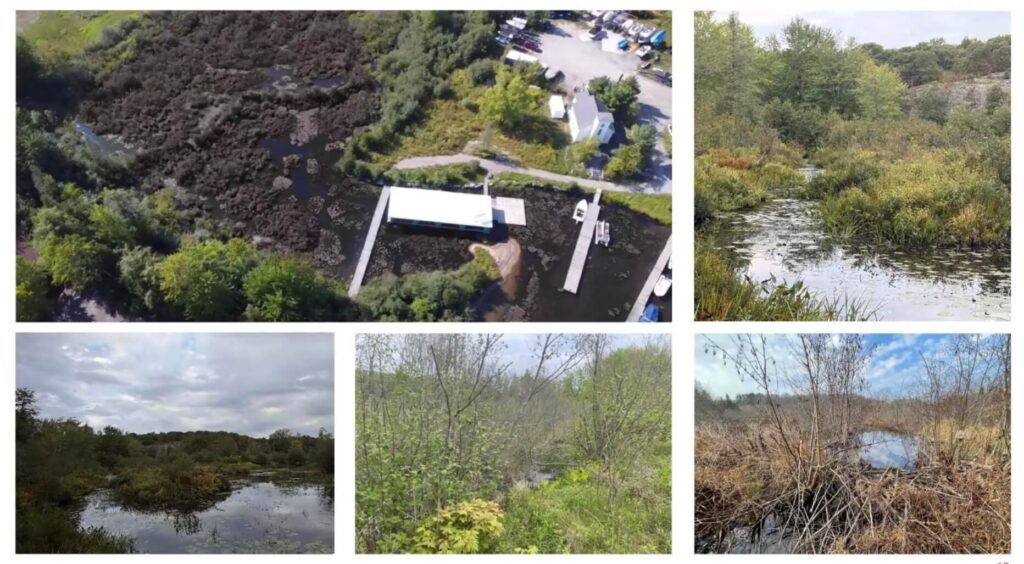
That sounds cautious. But in the process, Council also made a key change that shifts how we deal with a high-functioning wetland on Lake Rosseau.
TL;DR – What Council Did (and Didn’t) Decide on OPA 64
- No, this wasn’t an approval. Council deferred a decision on OPA 64 (policy changes for Minett) and ZBA 22-23 (zoning for Phase 1).
- Yes, they changed the conditions. They removed a staff-recommended provincial wetland evaluation (OWES) that could have confirmed whether the wetland should be treated as Provincially Significant.
- In its place, they’re asking the developer for a “wetland compensation and net environmental benefit and enhancement” plan across the developer’s landholdings, plus completion of the Environmental Impact Study (EIS) peer review.
- Phase 1 still depends on cabins and other resort uses in and beside a mapped wetland and within the floodplain, with looser shoreline protections than we have today.
- Whatever happens at Minett will be used as the measuring stick for future wetland and floodplain proposals on Muskoka’s lakes.
- You can read the unofficial full transcript of the Clevelands House OPA 64 planning meeting here: https://cottageinmuskoka.ca/clevelands-house-planning-meeting-opa-64-transcript/
Bottom line: this meeting quietly moved us from “prove this wetland isn’t Provincially Significant” to “assume the impacts and see if compensation elsewhere can make up for it.”
What Happened at the Clevelands House Planning Meeting
This was a formal public meeting under the Planning Act for the Minett redevelopment, focused on OPA 64 and the first phase of zoning (ZBA 22-23). The developer’s team walked through their vision for a revived resort village, staff and peer reviewers tested that against Township, District, and provincial policy, and residents and groups like the Muskoka Lakes Association weighed in.
Council’s final motion that day was to defer the decision – but with altered conditions that matter a lot for the Clevelands House wetland.
A quick word about the public meeting
Public meetings like this are required under the Planning Act, but it’s worth remembering: the developer’s presentation is a polished sales pitch, not neutral analysis.
Staff and peer reviewers are there to test whether that story actually lines up with our Official Plans and with provincial policy. In this case, the biggest friction point is the wetland and the micro-cabins.
What the Developer Is Asking to Change in OPA 64
In plain language: the ask is to let more things be built closer to the water, and inside areas that are currently treated as wetland and floodplain, and then rely on compensation and “net benefit” to square that with policy.
Through OPA 64, the applicant is asking to rewrite parts of the existing Minett policies (OPA 56) so that:
- Development inside wetlands can include:
- Resort accommodation units (cabins, etc.),
- Recreation uses (courts, amenities),
- Resort commercial uses,
- Plus trails and boardwalks.
- The current “no loss of wetland function” test can be softened so that if it can’t be met, “enhancement and/or compensatory measures” may be used instead.
- Floodplain rules change:
- Right now: habitable buildings aren’t allowed in the floodplain (just boardwalks/trails).
- Proposed: recreation and resort-related uses and resort accommodation would be allowed in the floodplain.
- Shoreline setbacks change:
- Right now: a 20 m setback from the shoreline is required for development, with limited exceptions.
- Proposed: resort accommodation up to 2 storeys could be allowed within 20 m of the shore in some cases.
- Vegetative buffer protections are relaxed so that flexibility that currently applies to certain amenity buildings (like a wellness centre) would be extended to commercial and residential accommodation, letting more buildings push into the 50-foot buffer.
The Wetland, the Micro-Cabins, and the Environmental Impacts
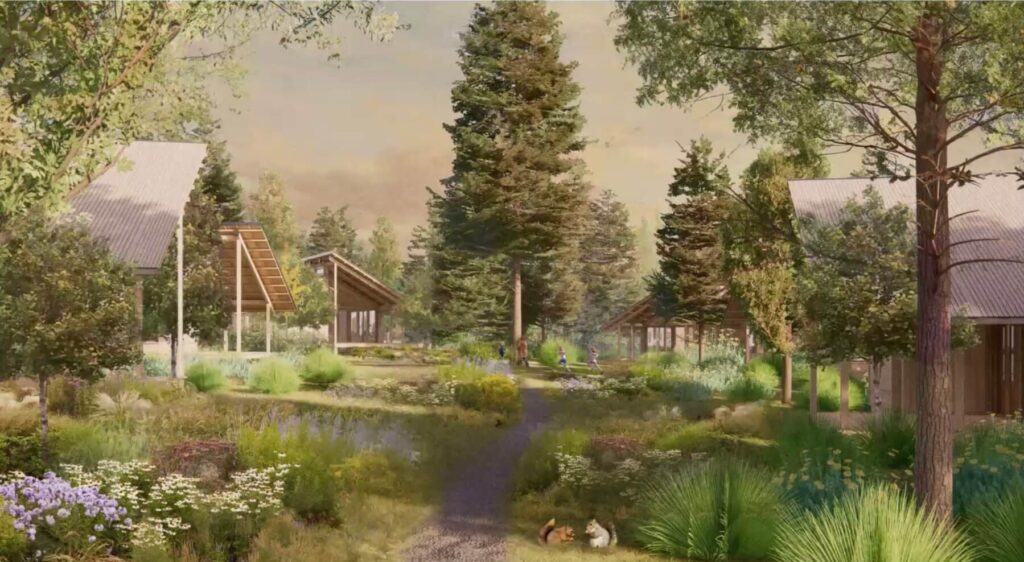
At the heart of this file is the Clevelands House wetland, where five “micro-cabins” and other resort uses are proposed inside or immediately adjacent to mapped wetland and floodplain areas.
- Five “micro-cabins” are proposed within an area identified as high-functioning wetland, built on stilts.
- Additional cabins and amenities are clustered very close to the wetland and the shoreline.
The developer’s narrative
The wetland is described as a “dense thicket” that is unsafe, unclear at the edges, and unattractive.
They argue that historically it was more of an open marsh / back bay, and that golf course grading, drainage changes, beaches, bridges, and so on have degraded it.
They say they want to “restore its historical functionality” by:
- Removing the thicket vegetation,
- Creating more open water and marsh conditions,
- Adding boardwalks and micro-cabins,
- Selling this as a “light-touch,” immersive nature experience.
The micro-cabins are marketed as:
- On stilts,
- Very small (all 5 together under 3,000 sq ft),
- “Iconic,” “affordable,” “world-class experience.”
We were told this wetland “reset” is integral to the whole concept – if they can’t do it, the plan as designed doesn’t really work.
What the Environmental Impact Study actually says
What the Environmental Impact Study (EIS) says is more sobering:
- The wetland is mapped with low, moderate, and high-functioning areas, but the criteria for those categories aren’t clearly explained.
- The proposal involves loss of multiple types of wetland:
- Loss of 0.69 ha of low-functioning wetland,
- Loss of 0.17 ha of moderate-functioning wetland,
- Loss of 0.25 ha of high-functioning wetland,
- Additional impacts on 0.96 ha of high-functioning wetland,
- Only 0.87 ha of wetland proposed to be restored.
- The 5 micro-cabins in the high-functioning area have a footprint of about 2,756 sq ft.
Significant wildlife habitat is flagged, including:
- Bat maternity colonies,
- Turtle wintering and nesting areas,
- Amphibian breeding habitat,
- Habitat for species of conservation concern (musk turtle, ribbon snake, snapping turtle, eastern wood-pewee, etc.),
- A furbearer movement corridor (mink, otter, fisher, eastern wolf, etc.).
In the inlet, fish habitat is mapped as Type 1 (most sensitive).
- Proposed dredging would permanently alter about 93,624 sq ft of this habitat (spawning, rearing, refuge).
- This would require approvals from DFO and the Province because it is a harmful alteration of fish habitat.
Potential habitat for endangered or threatened species is identified, including Blanding’s turtle, eastern hognose snake, endangered bats, and Massasauga rattlesnake.
The EIS straight-up acknowledges that the proposal is not fully consistent with provincial wetland policy as written now.
Staff also pointed out that aerial photos back to 1987 show this area as a vegetated wetland, not clearly as open water – so the idea that we’re just returning it to some pristine open-water past (as claimed in yesterday’s meeting) is, at best, debatable.
Put simply: we’re talking about losing portions of a high-functioning wetland and permanently altering sensitive fish habitat, in exchange for a “light-touch” cabin experience.
What Staff Recommended vs. What Council Changed
Planning staff were clear that this is not a minor zoning tweak. To move forward, the proposal needs:
- Changes to the Township’s Minett policies (OPA 64), and
- Changes to the District of Muskoka Official Plan, because the District currently:
- Requires a 20 m setback for commercial / residential accommodation, and
- Only allows shoreline flexibility in limited cases (e.g., for amenities like a wellness centre, not for accommodation).
Staff recommended deferring the decision and requiring three key things before this comes back:
- A formal OWES wetland evaluation by a certified ecologist, to see if the wetland should be designated as a Provincially Significant Wetland (PSW) under the 2024 Provincial Policy Statement.
- A finalized Surface Water Impact Assessment.
- An updated floodplain memo with a clear flood line and hard numbers on how much fill would be needed to get buildings above the hazard (and no “wave uprush” factor that the PPS doesn’t allow here).
Council kept the deferral, but removed the OWES requirement.
Instead, they now require:
- Completion of the peer review of the EIS, and
- A “wetland compensation and net environmental benefit and enhancement” plan that:
- Addresses the impacts on the wetland, and
- Shows an overall net environmental benefit across the developer’s landholdings, with sufficient enhancement measures and monitoring, to the Township’s satisfaction.
Surface water and floodplain work are still required. But the key shift is this:
Instead of first asking “Does this wetland meet the bar to be treated as Provincially Significant?”, the focus has shifted to “If we permit these impacts, can a ‘net environmental benefit’ package elsewhere on the site justify them?”
That shift in how we handle Lake Rosseau wetland compensation is a little worrying.
Why This Wetland Decision Matters Beyond Minett
Two reasons this isn’t just a Minett story:
- It normalizes building in wetlands and floodplains – if you can tell a good compensation story.
- If cabins and resort buildings in a mapped high-functioning wetland and in the floodplain are ultimately approved here, even with a compensation package, it becomes much harder to say “absolutely not” to similar requests around the lakes.
Other developers will point directly at this file. Groups like the Muskoka Lakes Association made it clear at the meeting: they support seeing Clevelands cleaned up and appreciate the reduced density, but they are concerned about the precedent of putting resort units in wetlands and floodplains and loosening shoreline protections.
“The concern for us is also any precedential value. As some of you may know, the Muskoka Regional Centre – the Province is proposing to sell that. Cliff Bay in Muskoka Bay on Lake Muskoka. And they’re proposing 31 resort units in the lake and two restaurants actually in the lake – and they’re pretty significant-sized restaurants.”
— Ken Pearce, President of the Muskoka Lakes Association
For Lake Rosseau and Muskoka cottage owners, this isn’t abstract policy. If this kind of “build in the wetland, compensate elsewhere” approach is normalized at Clevelands House, it becomes harder to argue against similar asks beside your bay, your kids’ swimming area, or the places you value most on the lake.
If the Clevelands House wetland decision in Muskoka Lakes becomes the template where “build first, compensate elsewhere” is endorsed, you can expect that logic to show up at other planning tables.
What’s Next for Clevelands House, Minett, and Lake Rosseau
This file is far from done.
Before the next major meeting (expected to be a joint Township–District meeting):
- The EIS peer review has to be finished.
- The developer must put forward a detailed wetland compensation/ net environmental benefit plan and get it past staff and peer review.
- Surface water and floodplain questions must be answered.
- The District of Muskoka will be directly involved through its own Official Plan Amendment process
We can absolutely support cleaning up Clevelands House and bringing life back to Minett without quietly shifting the line for future developments on what’s acceptable in Muskoka’s wetlands and floodplains. What Council and the District do next with the Clevelands House wetland will tell us which path they’re choosing.
If you’re considering buying or selling on Lake Rosseau or in Muskoka Lakes, Catharine can meet with you one-on-one, walk you through what OPA 64 and the Clevelands House redevelopment mean for your property, and help you plan your next steps.
FAQs: Clevelands House Wetland & OPA 64
Is the Clevelands House Minett redevelopment approved yet?
No. Township of Muskoka Lakes Council deferred a decision on OPA 64 and the related zoning by-law amendment (ZBA 22-23). Phase 1 of the redevelopment, including cabins and micro-cabins in and beside the wetland and floodplain, is not yet approved. The file now hinges on peer review, floodplain and surface water work, and the proposed wetland compensation/ net environmental benefit package.
What is OPA 64 and how does it affect wetlands at Clevelands House?
OPA 64 is a proposed Official Plan Amendment that would rewrite parts of the existing Minett policies (OPA 56). Among other things, it would allow resort accommodation and recreation uses inside mapped wetlands and floodplains, rely more heavily on compensation and “net benefit”, and loosen some shoreline setback and buffer rules. In practice, it would set the policy basis for building in and around the Clevelands House wetland.
Why does the Clevelands House wetland decision matter for other Muskoka lakes?
Because whatever is ultimately approved here will be used as a precedent. If Council and the District sign off on cabins and resort buildings in a high-functioning wetland and in the floodplain, compensated by enhancements elsewhere on the site, other developers around Lake Rosseau, Lake Muskoka, and beyond will point back to that decision. It makes it harder to insist on stricter protection for wetlands beside other cottage properties.
Can cabins be built in wetlands and floodplains at Clevelands House in Minett?
Right now, our Official Plans are more restrictive: habitable buildings aren’t supposed to be in the floodplain, and there are strong protections for wetlands and shoreline buffers. The current proposal for Clevelands House in Minett asks to change those rules so that cabins and other resort buildings can be placed in and beside the wetland and within the floodplain, as long as a wetland compensation and net environmental benefit package is provided. Whether that approach is ultimately accepted is what this OPA 64 process will decide.