
Crib dock repair in Muskoka Lakes is one of those projects that looks simple until you try to do it “just a little bit.”
You notice the dock feels lower than it used to. The surface tilts. Maybe the stringers look tired. Maybe you can literally see daylight where rock used to be. And the temptation is obvious: top up the cribs, level it out, move on.
Here’s the problem: in the Township of Muskoka Lakes, what feels like “maintenance” can quickly become structural work, and structural work tends to come with permits, timing windows, and paperwork. That’s not fear-mongering – it’s how the rules are written.
Important: This article is informational only (not legal advice). Requirements can be site-specific. Before any work, confirm your property’s requirements with the Township and the appropriate provincial/federal agencies.
Why this article is called “The $50,000 Rock”
Most crib refills won’t cost $50,000. The headline is shorthand for what actually happens on Muskoka waterfront projects:
- You start with “a bit of rock.”
- You discover the crib is failing or the stringers are compromised.
- You realize the Township treats the work as permit-required.
- You learn there are timing restrictions for in-water work.
- You need a contractor, sometimes an engineer, and often a proper plan.
The “rock” isn’t what gets expensive. The expensive part is doing it correctly – and being able to show a clean story later if you ever sell.
What “refilling a crib dock” actually means
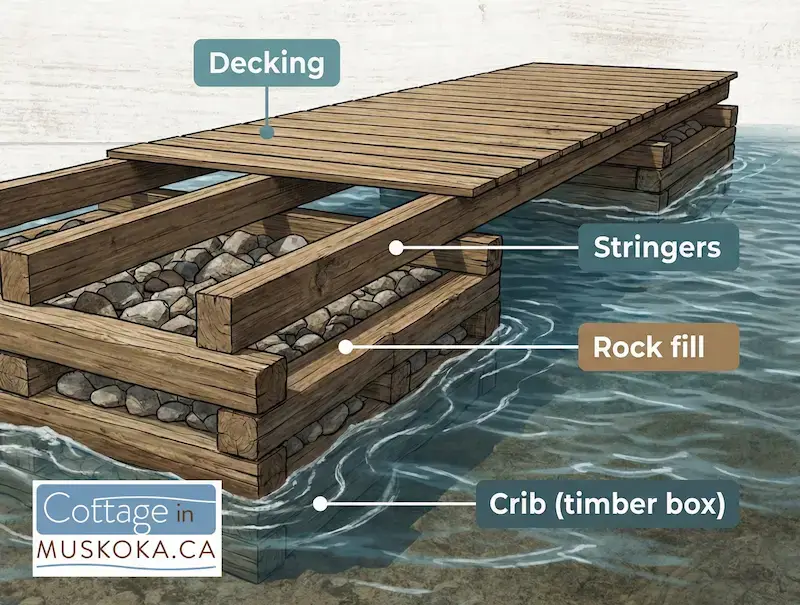
A crib dock is a fixed dock supported by timber “boxes” (cribs) that sit on the lakebed and are filled with rock for ballast and stability. When people say they want to “refill” a crib dock, they usually mean one of these:
- Topping up rock that has washed out due to ice, waves, and boat wake.
- Re-levelling low or settled cribs so the dock isn’t sloping or flexing.
- Stabilizing the base so the dock feels safe again.
- Discovering (too late) that the timber crib or stringers need repair or replacement first.
If you only take one thing from this guide, take this: cribs and stringers are structural. When you touch structural members, you are rarely in “casual DIY” territory in Muskoka Lakes.
The rule that surprises people in Muskoka Lakes
The Township of Muskoka Lakes’ own dock permit requirements are blunt:
- Any “repair” work on stringers or cribs – above or below the waterline – requires a building permit.
- Replacement of decking only does not require a permit.
- Adding any new crib area requires a permit.
That’s why the “just topping it up” plan can backfire. A refill project often involves opening the dock, discovering rot or movement, and then – without intending to – you’re doing exactly the kind of work the Township calls out.
The three buckets of approvals that can apply
1) Municipal: Township of Muskoka Lakes building permit
If you’re repairing cribs or stringers in Muskoka Lakes, assume you need to talk to the Building Department early. The Township document also states that applications require a site plan and construction drawings showing location and sizing of structural members.
And if your dock supports a structure (boat port/ boathouse), the Township document states that structural members are to be sized by a P.Eng or a designer qualified with a structural BCIN.
2) Provincial: MNRF “shore lands / lakebed contact” and the 15 m² threshold
The same Township document summarizes MNRF requirements in plain language:
- Docks and single-storey boathouses with 15 m² or less in physical contact with shore lands (lakebed) are generally not reviewed by MNRF.
- A work permit can still be required for certain activities on shore lands – for example, installing cribs with a cumulative area of more than 15 m² in physical contact with shore lands (lakebed).
- An MNRF Land Use Permit or letter of authorization may be required to be submitted with building permit applications.
Ontario also publishes timing-window guidance for in-water work (separate from Muskoka Lakes specifically): https://www.ontario.ca/page/water-work-timing-window-guidelines
3) Federal: DFO fish habitat + Fisheries Act responsibilities
The Township PDF includes a DFO section that points owners to a core reality: if your project is taking place in or near water, you’re responsible for understanding impacts and taking measures to avoid/mitigate impacts to fish and fish habitat – and requesting authorization when it’s not possible to avoid/mitigate impacts.
Source (Township PDF): https://www.muskokalakes.ca/media/qhan0cch/bldg-permit-requirements-for-docks-2021.pdf
DFO also publishes Ontario timing windows information here: https://www.dfo-mpo.gc.ca/pnw-ppe/timing-periodes/on-eng.html
If you want to understand why people get nervous about “just dropping rock,” read the fines sections in the Fisheries Act itself: https://laws-lois.justice.gc.ca/eng/acts/F-14/section-40.html
Before you move anything: the “clean story” checklist
This is the checklist that protects you as an owner and it protects you even more if you plan to sell.
- Confirm your municipality. “Muskoka” isn’t one rulebook. If you’re in Muskoka Lakes, start with the Township dock requirements PDF above. If you’re elsewhere in Muskoka, feel free to email Catharine – she will point you in the right direction. cath@cottageinmuskoka.ca
- Define the scope in one sentence. Are you replacing deck boards only? Or touching cribs/stringers? That single distinction changes everything.
- Confirm whether the footprint is changing. “No change in footprint” is usually a much cleaner file than “we extended it a bit.”
- Estimate physical contact area with the lakebed. The Township PDF discusses the 15 m² threshold in the MNRF section.
- Check timing windows. Don’t plan in-water work until you’ve confirmed timing restrictions and the best approach for your site.
- Document current condition. Take dated photos/video of the dock, crib levels, and any visible issues before anything changes.
- Talk to the Building Department before you spend money. It’s cheaper to ask early than fix a compliance mess later.
How to tell if you need a refill, a repair, or a rebuild
Owners often assume they need “more rock” when the real issue is structural. Here’s a practical way to think about it:
Refill / top-up is more likely when:
- The dock is generally level but has minor settling or a small low spot.
- The crib timbers look sound and the dock feels stable under load.
- The problem is clearly lost rock rather than failed structure.
Structural repair is more likely when:
- The dock has a noticeable slope, bounce, or “soft” feeling.
- Stringers show rot/cracking, fasteners are pulling, or sections move independently.
- Crib timbers are separating or you can probe soft wood near joints/waterline.
Full rebuild starts to make sense when:
- You see widespread rot or repeated shifting after multiple “fixes.”
- The dock alignment has moved materially (not just a small settlement).
- You’re spending money every year just to keep it barely usable.
Even if you’re “only refilling,” not doing a “full” crib dock repair, remember Muskoka Lakes treats crib/stringer work as permit-required. So the decision isn’t just technical – it’s also regulatory and resale-related.
What reputable contractors do differently
This isn’t a DIY how-to (and it shouldn’t be). It’s what separates a weekend “patch” from a dock that survives ice, inspections, and buyer scrutiny:
- They confirm permitting requirements up front (and can explain the why, not just the price).
- They plan around timing windows rather than forcing the calendar.
- They keep work contained (no loose rock spilling outside the crib footprint).
- They document the work so you have a clean paper trail for insurance and resale.
- They tell you when rock won’t solve it (because selling you rock for a failing crib is easy money – and bad practice).
Why this matters for buyers and sellers on the Big Three
On luxury waterfront, docks aren’t “extras.” They’re part of the lifestyle – and part of the due diligence. On Lake Muskoka, Lake Rosseau, and Lake Joseph, dock and boathouse structures tend to be larger, heavier, and more expensive to remedy if something is off.
If you’re buying: ask what work has been done, whether permits were pulled where required, and whether there’s documentation. A crib dock that “looks fine” can still be on the edge.
If you’re selling: the best strategy is to avoid last-minute, undocumented work. Either (a) fix it properly with the right paper trail, or (b) disclose clearly and price appropriately. “We threw some rock in” is not a reassuring sentence for a serious buyer.
Next step (and how we help)
If you’re dealing with a crib dock repair in Muskoka Lakes, we can help you pressure-test the plan before money gets spent.
To get useful guidance fast, send these details:
- Your lake + municipality (Muskoka Lakes vs other township)
- Whether the work is decking-only or involves cribs/stringers
- Whether the dock supports a boat port/ boathouse
- Photos of the low areas/ crib condition
Have questions about a crib dock before you buy or sell?
We can help you understand the due-diligence questions to ask in Muskoka Lakes and connect you with the right dock and permitting professionals.
FAQ: Crib dock repair and refills in Muskoka Lakes
Do I need a permit to refill a crib dock in Muskoka Lakes?
The Township of Muskoka Lakes dock requirements document says any “repair” work on stringers or cribs – above or below the waterline – requires a building permit, while replacement of decking only does not.
What’s the 15 m² rule people talk about?
The Township PDF summarizes MNRF requirements and notes that docks/single-storey boathouses with 15 m² or less in physical contact with shore lands (lakebed) are generally not reviewed by MNRF, while certain activities (e.g., installing cribs with a cumulative area over 15 m² in physical contact with the lakebed) can still require a work permit.
Are there timing windows for in-water work in Ontario?
Yes – timing windows are used to protect fish during critical life stages. Ontario guidance: https://www.ontario.ca/page/water-work-timing-window-guidelines and DFO Ontario timing windows page: https://www.dfo-mpo.gc.ca/pnw-ppe/timing-periodes/on-eng.html
Why can federal rules apply to dock work?
The Township PDF notes that projects in or near water may need to avoid/mitigate impacts to fish and fish habitat and seek authorization when impacts can’t be avoided. The Fisheries Act includes significant penalties for contraventions (see fines sections here): https://laws-lois.justice.gc.ca/eng/acts/F-14/section-40.html
Does it matter if I don’t change the footprint?
It can make the file cleaner, but in Muskoka Lakes, crib/stringer “repair” work is still treated as permit-required regardless of whether you expand. Always confirm with the Building Department.
If I’m selling, should I “just top it up” to make it look better?
Not as a shortcut. Undocumented structural work can create buyer questions later. Either fix it properly (with the right approvals/documentation) or disclose and price accordingly.