Last Updated: April 2026. Buying in Muskoka isn’t like buying a place in Toronto. In fact, it is frowned on for agents to risk their clients by representing them here. We would never represent a client on a condo purchase in Toronto – because we’re Muskoka waterfront experts! Buying a cottage in Muskoka is complicated by tiny details – shoreline rules, boathouse status, septic capacity, road access, STR licensing, water source and potability, and more – that can change what you can build, insure, finance, and enjoy. This guide is a risk-mitigation playbook for serious buyers.
Closing day on the dock – the ‘we did it’ moment! Photo shared with client permission.
“I was fortunate to talk with Catharine who was a wonderful agent for me. She has a perfect blend of enthusiasm and wisdom, while never being over-bearing or pushy. She was informative during the search but more importantly she was also helpful after the sale closed.”
The Muskoka Lifestyle in 2026 (What’s Changed, What Hasn’t)
Muskoka is still about water, wilderness, and the kind of place you return to for decades. What’s changed is how people choose: today’s buyers arrive informed, move faster on the right opportunity, and expect clarity on the details that affect enjoyment and long-term value. In 2026, the best properties don’t just look beautiful – they hold up beautifully under due diligence.
Choose Your Waterway (Big Three vs Hidden Gems)
Lake Muskoka
Lake Muskoka is the largest and most central of the Big Three – the “hub lake” that ties together Gravenhurst, Bala, Bracebridge (via the Muskoka River), and Port Carling/locks to Rosseau and Joe. It’s roughly 120-121 km², up to about 73 m deep, with around 269 km of shoreline.
How it feels
This is the most “mixed” Big Three lake: busy boating corridors and surprisingly quiet pockets layered together, with islands, heritage cottages, newer builds, and resorts all coexisting. It can feel social and lively in peak season – especially along major corridors – while still offering sheltered bays where mornings are calm.
What changes the experience (more than people expect)
-
Big-water exposure vs sheltered pockets: the open middle corridor can build real chop on windy days, while island clusters and narrower arms can feel more protected.
-
Town access is a real advantage: Lake Muskoka offers one of the strongest town networks for groceries, hardware, services, and events (Gravenhurst, Bala, Bracebridge, Port Carling).
-
Flood history matters here more than on the other two: major flood years in the watershed include 2013, 2017, and 2019, with 2019 setting record highs on Lake Muskoka/Moon River; exposure varies heavily by elevation and location (especially low-lying shoreline and constricted/outflow areas).
Micro-areas buyers notice immediately
-
Gravenhurst/ Muskoka Bay: very active, easy logistics, and a common “first touchpoint” for buyers coming up; some shallow arms can get weedy later in summer.
-
Bala Bay/ Moon River outlet: iconic village energy and walk/boat access to Bala – but this is an area where flood history and current/flow need to be treated seriously.
-
North end/ river-like arms toward Bracebridge & Port Carling: narrower water and different pacing than open mid-lake, with strong connectivity through the system.
Best fit if: you want classic Muskoka energy, multiple town options, and a wide range of cottage types – and you’re comfortable choosing location carefully based on exposure, traffic corridors, and water-level history.
Lake Rosseau
Lake Rosseau is a Big Three prestige lake with deep clear water, strong boating culture, and excellent connectivity: it links to Lake Joseph at Port Sandfield/Joseph River and to Lake Muskoka via the Indian River and Port Carling locks. It’s about 64 km², roughly 89 m max depth, with around 151 km of shoreline.

Scouting Lake Rosseau properties by boat – Catharine spends more days on the water than in the office in peak season.
How it feels
Rosseau is “classic Muskoka” – marinas, resorts, village stops, and long-standing family cottage culture. It’s lively in summer, especially in known corridors, but it’s generally a more curated, prestige-leaning lake than Muskoka’s full-spectrum mix. Lake Rosseau is full of interesting history – lots of historic estates.
Busy corridors vs quieter pockets
This lake’s activity is not evenly distributed. Warm weekends can feel very active – particularly around Minett, Port Sandfield, the Indian River, and the approach to the Port Carling locks – while quieter pockets exist in certain bays and shoulder seasons. Minett will be getting even busier in the next few years, with the Clevelands House redevelopment.
Rock hazards and shoals are a real part of Rosseau boating. The practical standard here is to use vetted charting (CHS chart 6022) and treat early runs like scouting missions until routes are familiar.
Micro-areas that define the Rosseau experience
There are a lot of opinions on the best places to buy on Lake Rosseau:
-
Minett / Clevelands House–JW corridor: resort energy, higher traffic, lots of movement between Rosseau and Joe.
-
Village of Rosseau (north end): true village feel with dock access and a strong sense of place.
-
Windermere (east shore): classic resort-and-golf landscape anchored by Windermere House and marina services.
-
Port Sandfield/ Port Carling access: prime connectivity, high-energy boating arteries in peak season.
Best fit if: you want prestige shoreline with real boating connectivity to towns/services — and you’re not expecting peak summer to feel quiet.
Minett Redevelopment Alert: What Lake Rosseau Buyers Need to Know
Buying near Minett? The Cleveland’s House project (OPA-64/ZBA-22/23) plans big changes: 48 cabins, wellness centre with spa/gym/restaurant, 17 outdoor sport courts, expanded marina (up to 215 slips), and new traffic via Juddhaven Road – all in wetlands/floodplains close to Lake Rosseau shoreline.
This ramps up activity in an already busy resort spot: more boats, visitors, noise, and road traffic that could affect your peaceful cottage life, views, or future renos.
Status (Feb 2026): OPA-64 complete Oct 2025; now post-public meeting (Nov 25, 2025) – construction approval pending, timelines accelerating.
Looking at a cottage near Minett on Lake Rosseau? Catharine can walk you through the planning files and highlight exactly what matters to you.
Township Source: Engage Muskoka Lakes
Lake Joseph
Lake Joseph is the Big Three’s “quiet luxury” reputation: deep, cold, famously clear water, dramatic granite shorelines, and a higher share of legacy and luxury holdings. It’s roughly 5,460 hectares (~13,500 acres) with around 90 km of shoreline (excluding every inlet/island), and about 93 m max depth.
How it feels
Lake Joe can feel private and calm in a way that surprises people – not because there are no boats, but because the lake’s layout (arms, bays, islands) and the ownership profile often produce a quieter day-to-day vibe outside of key corridors. It’s also a lake where “the shoreline is the asset,” so waterfront etiquette and wake awareness matter.
Connectivity (yes, but it’s a day trip)
Lake Joseph connects to Rosseau at Port Sandfield and from there to Lake Muskoka through Port Carling locks – doable by boat, but it’s not a quick hop; it’s an outing.
North vs south: a real decision point
-
South end/ Foot’s Bay side: closer to Hwy 400/69 and often more practical for frequent weekend use; Foot’s Bay includes a public launch and nearby basics via MacTier.
-
Central & east arms: classic “Lake Joe” vistas, islands, and a mix of sheltered water and exposed points.
-
North end/ Hamer Bay & Little Lake Joseph: stronger “end of the map” privacy; Gordon Bay Marine is a key service hub, and Little Lake Joseph is noted for a quieter, tucked-away feel.
Micro-areas buyers ask about most
-
Foot’s Bay: convenient entry point; can feel busier near launch/marina routes.
-
Cox Bay/ Stanley Bay/ Eastern Arm: postcard Muskoka rock-and-pine look with big-water views and deep swimming off many docks; some points are windier/wavier.
-
Stills Bay & surrounding inlets: calmer, more sheltered water where wakes are more noticeable and etiquette matters.
-
Hamer Bay/ Gordon Bay (far north): understated high-end, larger properties, and big-water/north-end sunsets; errands can involve more drive time.
Best fit if: you prioritize water clarity, privacy, and a quieter luxury feel – and you’re comfortable that boating to other hubs is more of a planned outing than a quick convenience.
“We ended up purchasing a beautiful cottage on Lake Joseph that summer. We have asked for advice and guidance with regards to real estate over the past few years, and we consider them a trusted advisor. Clearly, we would recommend them highly.”
Secondary Lakes + “Different Pace” Options
Not every buyer is drawn to the energy of the “Big Three.” Muskoka’s secondary lakes offer a quieter rhythm, slightly softer pricing, and different trade-offs when it comes to access and year-round usability.
Lake of Bays – The eastern anchor of Muskoka, Lake of Bays has a grand scale and a lively village scene around Dorset, Dwight, and Baysville, but it still feels less polished than Rosseau or Joseph. Properties often have larger lots and a more relaxed feel. Winter accessibility is good, though exposed shorelines can feel wilder once the snow sets in.
Skeleton Lake – One of Muskoka’s clearest and deepest lakes, Skeleton has an almost Caribbean hue on sunny days. Its rocky, elevated lots and limited public access keep it low-traffic. Don’t take that to mean everything on Skeleton Lake is elevated – there are still appropriate lots for those of us that prefer something more level! Buyers trade some convenience – longer drives, fewer services – for true seclusion and exceptional water quality. Winters here are quiet and occasionally rugged.
Mary Lake – Linked to Fairy and Peninsula Lakes via the Huntsville waterway, Mary combines small-lake calm with proximity to town. Easy highway access and nearby amenities make it one of the more practical “secondary” options for those planning year-round use. Ice fishing huts dot the bay all winter, a reminder that this is a four-season community.
Georgian Bay – beyond Muskoka’s core lakes, the Bay offers an entirely different rhythm – open horizon, wind, and granite outcrops instead of sheltered coves. It’s coastal living in cottage country form. Access and exposure can be challenging in winter, but for some buyers, that vast, raw landscape is exactly the appeal. Great care must also be taken when boating – there are many hazards, but also a very real risk of getting lost. So, this is not the place to wander unprepared. However, it is deeply appealing to adventurous types.
Rivers: Muskoka River & Moon River
Rivers deliver waterfront at a different scale — narrower lots, dynamic water levels, and unique regs that shift buyer priorities from views to access stability and flood resilience. Steeper banks mean less buildable shore, tighter dock setbacks, and septic systems tested by fluctuating hydrology.
Muskoka River – Bracebridge-to-Huntsville corridor offers solid road access and town services, but shared rights-of-way and seasonal roads demand road association fees ($500–$2k/yr). Easier permitting for smaller docks; winter plowing reliable but check private road agreements.
Moon River – Bala-to-Georgian Bay run has rugged appeal, but remoteness means longer drives or water-access only for some. Flood history (2019 peak submerged 10+ ft) hits docks/septics hard — mandate elevation surveys and FOCA floodline maps pre-offer. Higher insurance premiums common.
Check your lot against District floodlines here: Muskoka Floodplain Maps & Water Levels. Follow on Instagram @cottageinmuskoka for real-time spring coverage – we report more on spring water levels than just about anyone, and share live water level submissions to our stories.
The 2026 Market Reality for Buyers
If you’re entering the Muskoka waterfront market in 2026, here’s what you’re actually walking into – because the landscape has shifted significantly from the frenzy of a few years ago, and that shift works in your favour if you use it well.
You have more selection than buyers have had in years. Active waterfront listings across Muskoka climbed from roughly 204 in 2022 to over 500 in 2025 – while sales stayed in the mid-500s. That’s not a dead market. People are still buying. But buyers now have the ability to compare, take their time, and wait for the right fit instead of scrambling to make rushed decisions. That’s a meaningful change from even two or three years ago.
Muskoka is not one market – and where you’re looking changes your leverage. The Big Three lakes (Muskoka, Rosseau, Joseph) and Bracebridge still trade at a relatively healthy pace, roughly 7–8 months of inventory. But areas like Lake of Bays, Georgian Bay, and Huntsville are running at 13–15 months – which means significantly more negotiation room and longer timelines to make decisions. Your strategy should match your area, not a Muskoka-wide headline.
Be cautious with “average price” headlines. A few high-end sales can pull the average way above what most buyers are actually spending. In the Township of Muskoka Lakes, for example, the average waterfront sale price in 2025 was $2.51M – but the typical sale (median proxy) was closer to $1.46M. That gap exists in every township. Knowing the difference helps you set realistic expectations and avoid anchoring to a number that doesn’t reflect the property you’re actually looking at.
Conditions and negotiation are back on the table. Sale-to-list price ratios across the region ran between about 91% and 96% in 2025, depending on the area – meaning sellers are routinely accepting below asking. More importantly for you as a buyer, this is a market where you can include proper conditions on your offer: financing, inspection, septic and well testing, survey review. You don’t have to waive everything and hope for the best. That matters enormously in Muskoka, where the technical details below can turn up surprises that you want the ability to walk away from.
For a full township-by-township breakdown – including months of inventory, days on market, sale-to-list ratios, and pricing trends since 2019 – read our Muskoka Waterfront Market Report: 2026 Outlook.
More selection and more negotiation room means you can, and should, do thorough due diligence. The sections below walk you through exactly what to verify before you offer.
Island vs Mainland (Logistics + Privacy Trade-Off)
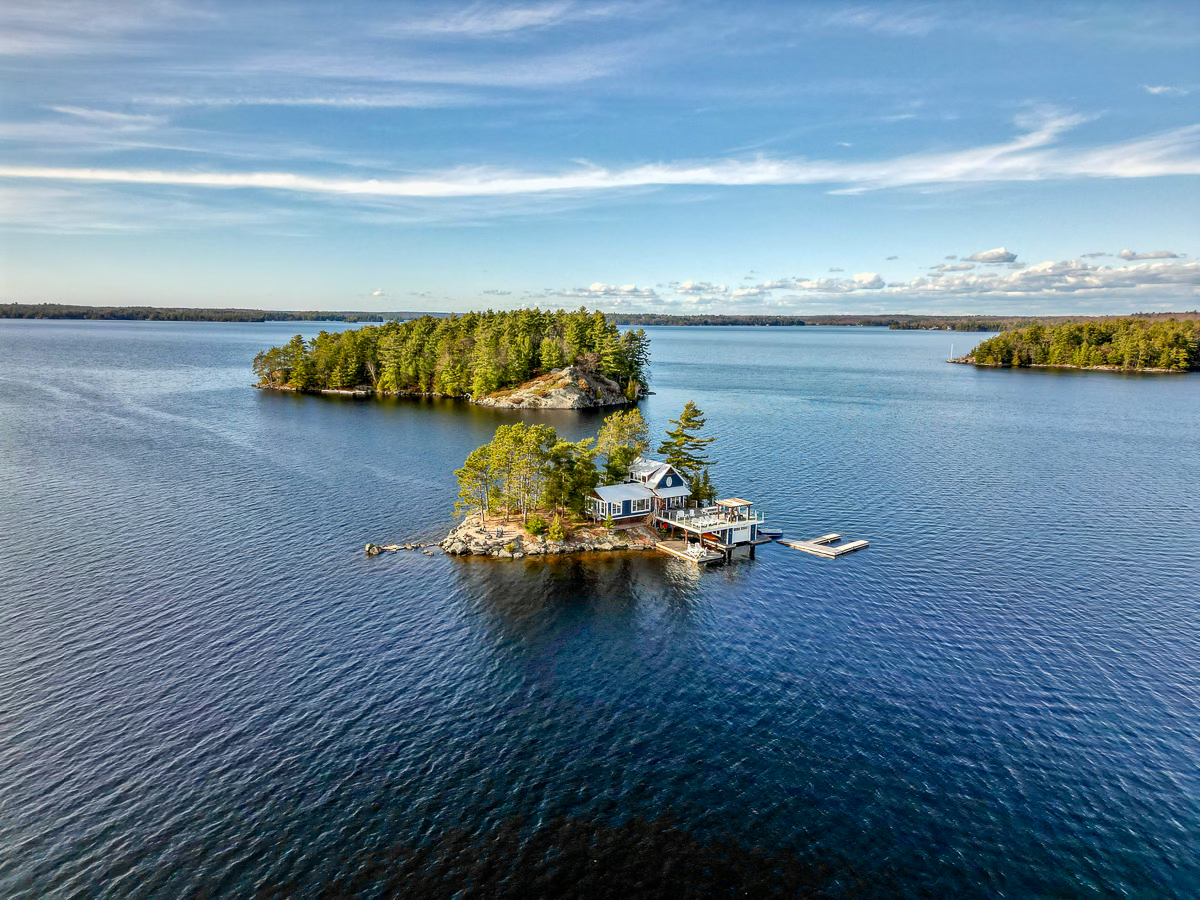
Boat-access island cottages on Lake Muskoka come with huge views – and real logistics to plan for.
Island life is magical – until you’re planning deliveries, winterization, or insurance. Or until, god forbid, there’s an emergency. We have seen many people sell their island properties once they start to age, and the thought of having to boat to the mainland in an emergency starts to cause stress.
Consider if this is your long-term cottage, or a stepping stone cottage. Do you intend to retire here? If so, you may consider mainland – though some still opt for islands! Once you get past the logistical hurdles, it all comes down to personal comfort level.
Logistics Checklist:
- Can emergency services realistically access?
- How do trades and materials get in?
- What’s the winter plan (power, heat, checks)?
- Will insurers and lenders treat this as higher risk?
- Boat access realities, deliveries, emergencies, winterization
- Insurance implications
The Muskoka Technicalities
Shoreline Rules, Setbacks, and What Buyers Should Verify
Shoreline setbacks and permissions aren’t one universal rule. They depend on:
- Your municipality
- Your zone (waterfront/shoreline residential variants)
- Your lake classification/ schedules (where applicable)
- Your lot geometry (irregular shorelines trigger special measurement rules)
Setback Definitions: Defined by zoning, shoreline type, and lake classification.
Buyer Takeaway: Before you assume you can rebuild or expand, confirm:
- Legal status (permitted vs legal non-conforming)
- What’s actually permitted today
- Whether “measurement rules” reduce your usable envelope
Concrete Example (Muskoka Lakes):
Two-storey boathouses treated differently; setbacks reference side/rear lot lines and straight line projections. The Township’s consolidated zoning by-law defines two-storey boathouses and includes specific setback requirements for the two-storey portion (including rules tied to side/rear lot lines and “straight-line” measurement). Use this as a model for how to verify your own property – because the exact rules depend on zone and lake classification. Or, get in touch with a local real estate agent!
Straight Line Projection (Plain English):
In Muskoka Lakes, the side lot lines are “carried on” into the water from the high water mark for 30.5 m (100 ft.) to create an invisible side-yard boundary for docks and boathouses. In simple terms, imagine your side lot lines continue out into the lake in the same direction they run on land. Your in-water structures have to stay the same minimum distance away from those projected lines as they do from the lot lines on shore. On irregular shorelines and tight bays, this can really shrink the legal area for a dock or boathouse and it prevents owners from “wrapping” structures around points or into bays in front of neighbouring properties.
The Boathouse Factor (Non-Conforming vs Rebuildable)
A boathouse can be emotionally compelling – and financially dangerous, if its legal status is misunderstood.
Three Truths Buyers Need:
- “Existing” doesn’t automatically mean permitted today
- “Legal non-conforming” doesn’t automatically mean rebuildable if destroyed
- Insurance and financing can change dramatically based on status and risk
Legal Non-Conforming Definition:
Structures that pre-date current zoning (Planning Act s. 24(1)). Maintenance is allowed, but rebuilding after destruction (e.g., >75% damage) or expansion is NOT guaranteed and usually requires Committee of Adjustment approval.
Concrete Example (Muskoka Lakes):
The Township’s consolidated zoning by-law defines two-storey boathouses and includes specific setback requirements for the two-storey portion (including rules tied to side/rear lot lines and “straight-line” measurement).
Muskoka Lakes Specifics:
- Two-storey boathouse height >4.9m (16ft) or sundeck roofs require 13.7m (45ft) setbacks
- Use this as a model for how to verify your own property – because the exact rules depend on zone and lake classification
Source: Muskoka Lakes Consolidated Zoning By-law
| Township | Key Rules Summary | Official Zoning/Bylaw Links |
|---|---|---|
| Muskoka Lakes | Boathouses permitted in Waterfront Residential (WR) zones; dock permit required first; engineering review for upper structures; cumulative width limits apply to non-conforming additions post-1988; two-storey allowed on Category 1 lakes (Joseph, Rosseau, Muskoka) with 91.4m+ frontage. | Comprehensive Zoning By-law 2014-14 Building Permits |
| Gravenhurst | Land Use Permit from MNRF needed for single-storey boathouses >15m²; 75% shoreline natural state; MNRF work permit for docks/boathouses. | Zoning By-law 10-04 |
| Bracebridge | Building/site plan approval required; specific waterfront rules in Zoning By-law 2016-088 (details via planning dept). | Permits |
| Huntsville | Building permit + site plan approval required; boathouse/boatport ≤100m² floor area, ≤10m width, complies with side yards; flat roof for sitting doubles side yard; cumulative shoreline structures ≤15m or 25% frontage; max 2 structures (dock + boathouse +1). | Docks/Boathouses Page Zoning By-laws |
| Lake of Bays | Building/development permit required; boathouse ≤129m² (1500ft²), 75% of shoreline activity area; lot coverage ≤10%, shore yard ≤40%; no living quarters/sleeping cabins; DFO review may apply. | Dock Guide |
| Georgian Bay | Floating/in-water boathouses regulated in Zoning By-law 2014-75; cumulative shoreline structure width based on frontage (e.g., dock 2m + boathouse 8m example); height/width/length specs in schedules. | Zoning By-law 2014-75 Schedule D Zoning Diagrams |
Docks: Repairs, Replacements, and “Assume Nothing”
Dock work is one of the easiest places to get surprised post-closing. The risk isn’t “dock cost.” The risk is scope + approvals + whether it can be done as imagined.
Approvals: Differ by municipality + waterbody. Building permits required for most work beyond minor decking.
Crib Docks: Standard for rocky lakebeds. Repairs are complex (underwater access, bedrock blasting). And, you can cost yourself a whole lot of money trying to repair your crib dock without proper due diligence.
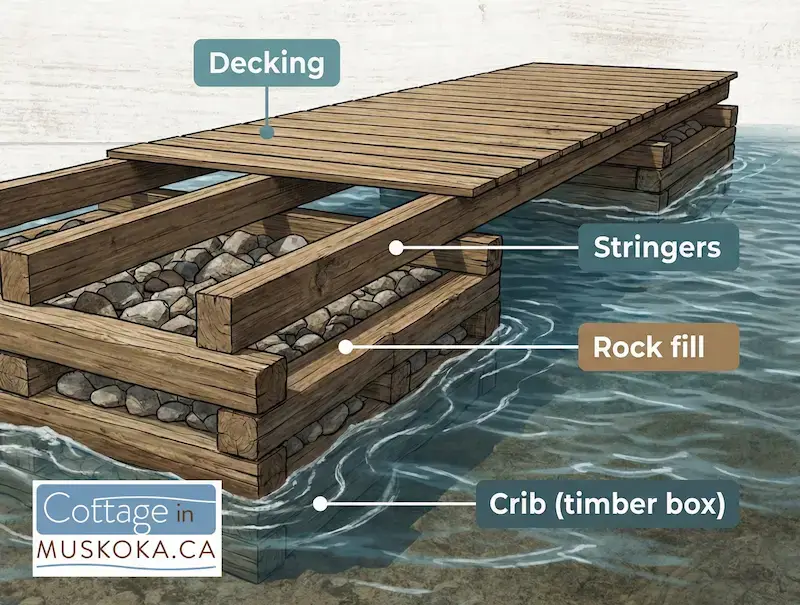
A crib dock is a timber “box” filled with rock, supporting the dock structure above.
Ask This Every Time:
- What’s existing, what’s permitted, what’s been grandfathered?
- Is it crib/ piling/ floating – and when was it last rebuilt?
- Are there records (permits, approvals, engineer docs if applicable)?
- Is any part on a shore road allowance or other non-owned land?
Septic + Water
Septic isn’t a small detail – it’s the system that can turn a dream into a major replacement project.
Class 4 Septic: Standard tank + leaching bed. Requires 15m clearance from surface water (OBC sets 10-15m; Muskoka often 30m+).
Minimum Standard: Know what system type you have, its age, and whether it’s sized for today’s bedrooms/use.
Smart Condition (When Appropriate): A real septic inspection that includes records review + system verification (not just a drive-by look).
Water Setups:
Lake Intakes:
- Common on Big Three due to iron in wells
- Need UV/filtration + heat tracing for winter
Drilled Wells:
- 100-200m deep
- Mineral buildup issues
Short-Term Rentals (STR): Licensing Is Moving Fast
STR rules are municipality-specific and can change quickly. Treat STR as a compliance + insurance diligence item, not an income promise.
Compliance: Rules are municipality-specific (e.g., Muskoka Lakes portal). Licenses are NOT automatically transferable.
Thinking about renting your Muskoka cottage on a short-term basis?
Before you buy, make sure you understand the local Short-Term Rental (STR) rules in the municipality where your cottage is located. Regulations, licensing, and enforcement vary by township.
Township of Muskoka Lakes – Short-Term Rental Accommodations
Town of Bracebridge – Short-Term Rental Accommodations (Licensing)
Town of Gravenhurst – Short-Term Rental Accommodations Program
Town of Huntsville – Short-Term Rental Accommodations
Township of Lake of Bays – Short-Term Rentals Licensing Program
Township of Georgian Bay – Short-Term Rental Guidebook (PDF)
These pages outline licensing requirements, fees, occupancy limits, and enforcement details for each area.
Buyer Move – Confirm:
- Is STR allowed here (zoning + licensing)?
- Is the current licence transferable (often not automatic)?
- Will your insurer cover STR use?
Shore Road Allowances (SRA)
SRAs are one of the most misunderstood Muskoka issues.
Definition: 66-foot-wide strips (unopened public roads) between the lot and the water.
Why It Matters:
- Public access risk
- Encroachments
- Approvals
- Insurance
- Resale
If an allowance exists between the lot and the water, you may not actually own to the water’s edge, and structures (docks, stairs) may sit on land you don’t own and are technically unauthorized.
How to Spot It Fast:
- Survey gap to water/ old plan references/ title notations
- Confirm via survey (look for a “gap”)
What Resolves It:
Abutting owners can apply to purchase the shore road allowance via the township’s planning department. Submit proof of ownership, sketch/survey, and fees; public notice and council approval follow, taking 3-18 months. Policy C-LS-08 governs closures; flooded portions may stay municipal unless for specific boathouses.
Key Costs
-
Application Fee: Ranges from $575 for flooded land sales to around $900–$1,187 in related townships or older Muskoka Lakes policies.
-
Land Purchase Price: Set per square metre or by appraisal (whichever is lower in some areas), such as $11–$17/m² in nearby Huntsville or per township schedules in Muskoka Lakes Policy C-LS-08. Exact Muskoka Lakes rates (e.g., varying by lake like Muskoka, Rosseau, Joseph) require contacting the township, as they follow acquisition rates in their fees bylaw.
-
Additional Fees: Surveys, legal, by-law preparation, registration, and possibly HST; applicant covers all.
Muskoka’s 6 Townships: Shore Road Allowance (OSRA) Purchase Examples
These regional examples illustrate typical 2024–2026 costs for closing/buying original shore road allowances (OSRA). Rates vary by waterbody, size/frontage, and year—always verify directly with the township clerk or planning department, as bylaws update annually and specifics depend on your property roll.
| Township | Example Rate | Application Fee | Key Notes & Link |
|---|---|---|---|
| Town of Bracebridge | Per sq ft (contact for rate); no public fixed m² | Contact for details | Custom pricing; notices published online. Verify via fees bylaw. Bracebridge OSRA Notice (example) |
| Town of Gravenhurst | Lake Muskoka: $91/ft (~$299/m) shoreline; others $67/ft (~$220/m) | $974/lot + $3,500 legal deposit | Linear frontage pricing above high water; HST extra. Sample: 392 ft = ~$35,672. Gravenhurst OSRA Policy PDF |
| Township of Georgian Bay | $12/m² SRA; $8/m² road allowance + HST | $1,150 legal deposit/property (+$100/add’l) | Per sq m; pre-consult required. Georgian Bay SRA Policy PDF |
| Town of Huntsville | Lakes: $17/m²; Muskoka River (Port Sydney–Stephenson Rd): $13/m² | $1,187 + $2,650 legal deposit | Example: 0.23 ha river = $29,900 + HST. Review for lake/river equity ongoing. Huntsville OSRA Page |
| Township of Lake of Bays | Per sq ft (township-set; contact) | $350–$650 (access apps); survey extra | No fixed public rate; waterfront-specific. Contact township. Lake of Bays Info |
| Township of Muskoka Lakes | Per schedule/policy (contact; no public $/m²) | ~$575–$900 (flooded/older) + legal/survey | Notices per roll; Policy C-LS-08. Examples via public sales. Muskoka Lakes Fees | Sample Notice |
Rates as of Feb 2026 searches; always confirm with township for your lot — processes take 3–18 months and require surveys/legal fees ($3k–$10k extra). Sources linked inline.
Financial Framework (For Serious Buyers)
Financing the Seasonal Asset (What Changes vs a Primary Home)
Lending: Differences based on road access vs. water access.
Lender requirements often differ for recreational properties (access, winterization, property type, and risk features like over-water structures).
Down Payment: Recreational properties often require larger down payments and stricter underwriting than primary residences; confirm with your lender early. (20-35% requirements typical for recreational properties, but verify with lender.)
Confirm financing feasibility early – especially for islands, private roads, and properties with older building systems.
Land Transfer Tax + Closing Costs (Ontario / Closing Cost Buckets Buyers Forget)
Beyond land transfer tax and legal fees, plan for:
Muskoka Buckets:
- Survey/ title review depth
- Septic/well tests
- Septic inspection/ water testing
- Insurance review + required inspections (woodstove/WETT, electrical, etc.)
- Road agreement costs
- Road agreements/ maintenance obligations
- Shoreline/ dock documentation
The Real Operating Costs (The “All-In” Model/ The “Carry Cost” Reality)
A premium cottage can have premium upkeep.
Insurance Quirks:
- Boathouse sundecks
- High-value outbuildings
- Wood stove (WETT) requirements
- Seasonal vs. year round
- Road access vs. water access only
- Accessibility for emergency services
Carrying Costs:
- Boathouse bubbler electricity
- Private road grading
- Septic schedules
Carry-Cost Checklist:
- Insurance + deductibles (especially waterfront risk factors + boathouse/dock features)
- Winterization + regular checks
- Private road plowing/grading cost share
- Dock/shoreline upkeep (and availability of trades)
- Generator/backup power expectations
Remote-Work Readiness (Internet + Cellular Reality)
Don’t guess from a listing. Verify at the address.
Best-Practice Verification Links:
- Use Canada’s national broadband mapping and provider checks to confirm fixed options at the address. Source: ISED Canada – National Broadband Map
- Test cellular where you’ll actually work (office spot, deck, dock), and plan a backup (dual WAN / hotspot) if reliability matters.
Starlink is widely available in Muskoka now, so that presents new options for areas that used to only have access to very slow, rural internet – but it is worth checking ahead of time.
Years ago we had someone come into our brokerage office to ask how they could get high speed. They had worked with an agent from Toronto who was no longer answering their messages – and we had to break the news that it wasn’t available at the cottage that agent had helped them to purchase. A cottage that they had hoped to work from…
These days, you’ll be able to get connectivity in most places – but be sure to do your due diligence!
Seasonal Realities
Winter Access: What “Privately Maintained Road” Actually Means
Responsibility: Plowing is private; no municipal snow removal on unassumed roads.
Ask:
- Who plows? What’s the cost share? Is there a written agreement?
- Is there a turnaround for emergency vehicles?
- What happens in freeze/thaw and spring mud season?
Checklist: Verify emergency access passibility and shared cost agreements.
Shoulder Seasons Are Inspection Season
Why October/May: Best time to see drainage, shoreline exposure, and dampness issues hidden by summer foliage/peak water levels.
October and May show what summer hides:
- Shoreline exposure and drainage
- Dampness, ventilation, musty basements/crawlspaces
- Septic performance signals
- Roof issues that become obvious under rain/temperature swings
Agent Note (From Inspection Reality): In practice, roofs and septic are common deal-killers when surprises show up during conditions – especially if replacement is imminent.
The Buying Process (The Professional Timeline – Muskoka Edition)
North Star: Legacy vs lifestyle vs investment goals.
- Define Your North Star (legacy vs lifestyle vs privacy vs rental compliance)
- Search (public + quiet opportunities/ “quiet opportunities” without hype/ off-market)
- Due Diligence: Survey, zoning, septic/well, permits, shoreline issues
- Survey, zoning confirmation, septic/water, permits, STR, access/roads, insurance
- Offer Strategy: Structure for protection (inspection, insurance, and STR clauses)
- Offer (protective, clean conditions)
- Closing: Use Muskoka-experienced legal counsel
- Muskoka-experienced legal counsel – because local title/shoreline/road issues are common. We can provide you with recommendations for third-party professionals.
“It truly was a blessing when Glenn and I walked into your office that day and found you!! Catharine always believed that we would find our perfect cottage (even when we weren’t so sure!). For three long years, she researched, investigated, and showed us properties on all three lakes. As we sit in our Muskoka chairs sipping our drinks, looking over our beautiful bay where the kids are playing in the water, we’ll be forever thankful to Catharine for her kindness, hard work, dedication and friendship.”
After Closing: The Muskoka Ownership Calendar
Muskoka ownership has a rhythm:
- Ice-out checks
- Spring flood watch (especially on Lake Muskoka, less so on Lake Rosseau, and even less on Lake Joe).
- Spring startup
- Summer maintenance
- Fall shutdown
- Winter monitoring*
*note – people often feel like they can skip the winter monitoring. We had record level snowfall last year (winter 2024-2025) that was heavy enough to cave a roof in!
The “Local Bench”: Identifying property managers, septic service, and dock contractors early.
Build Your Local Bench:
- Property manager
- Septic provider
- Dock/shoreline contractor
- Electrician
- HVAC
- Generator service
Buyer Q&A with Catharine, our Muskoka waterfront specialist
What are the biggest deal killers you’ve experienced when it comes to Muskoka cottages?
Roofs and septics top our Muskoka waterfront specialist Catharine Inniss’s list of deal killers – buyers bail on $20k-$60k headaches inspections uncover.
Catharine recalls a case where plywood clips were missing in the attic (panels not flush, prime for leaks/rot); she and her clients decided to move on after spotting it, dodging a major repair. Have a pro roof inspector check sheathing, flashing, ice shield – get quotes on 15+ year roofs.
Septics follow close behind: undersized tanks, saturated leach fields, or no pump-out records can mean expensive replacement costs. Catharine recommends a full Category 3 inspection by a third-party professional confirming daily capacity for your household, effluent quality, and reserve bed space; soggy fields or odours mean renegotiate or pass – cross-check township re-inspection files first.
Preparation and Financing
How do I get pre-approved for a cottage mortgage, and what down payment is required?
Start by contacting a mortgage broker or lender experienced in recreational properties; they’ll review your income, credit, and debt to issue a pre-approval letter, typically valid for 90-120 days. Cottage mortgages often require a 20-35% down payment (higher than urban homes due to perceived risk), though this varies by lender – confirm exact amounts and rates with a licensed mortgage professional, as realtors cannot advise on financing.
What are the differences between cottage mortgages and standard residential mortgages?
Cottage loans treat properties as seasonal/recreational, leading to higher interest rates (often 0.5-1% above primary residences), shorter amortization periods (up to 25 years), and stricter qualification based on your primary income rather than rental potential. They may also exclude properties without year-round road access – discuss your specific situation with a mortgage specialist to compare options.
How much should I budget for closing costs like land transfer tax, legal fees, and inspections?
Expect 1.5-3% of the purchase price, including land transfer tax (tiered rates up to 2.5% in Ontario, potentially doubled for non-residents), legal fees ($1,500-$3,000), title insurance ($300-$600), and Muskoka-specific inspections ($1,000-$4,000 for home, septic, well). Use Ontario’s LTT calculator and consult your lawyer for a precise estimate based on your deal.
Finding and Viewing Properties
How long does the property search typically take in Muskoka?
With 2026’s elevated inventory, buyers can take 3-6 months or longer to be selective – though well-priced niche properties can still sell quickly. Consult with a local agent – they can work with your timeline, and also may have access to off-market properties for you to consider.
Should I work with a local real estate agent, and what should I look for in one?
Yes, a Muskoka-specialized agent provides invaluable insights into lakes, zoning, and access – look for RECO registration, 5+ years local experience, strong seller networks, and testimonials on waterfront deals. Sign a buyer representation agreement to ensure their fiduciary duty is to you. People often think it’s best to work with the seller’s agent, assuming they’d know the most about the property. Be warned – working with the same agent can lower the duty of care they owe to you.
What’s the best time of year to buy a cottage in Muskoka?
Spring through summer (March-August) is prime for buyers, with peak inventory of fresh listings, easier property access, and full viewings of waterfront features under good weather. Late fall/winter (Oct-April) has less competition for motivated sellers but thinner, “stale” inventory and road access issues (e.g., no plowing). Winter can be a great time to negotiate, and a dedicated agent won’t be stopped by something like an unplowed road – we have snowshoed in before to preview a cottage for our client.
Making an Offer
How do I make a competitive offer in a multiple-offer situation?
Work with your agent to offer slightly above asking (5-10% in hot markets), minimize conditions, and include a strong deposit; a personal letter to sellers can also help. Remember, this is general advice – don’t just blindly offer above asking when the market is hot. Your agent will compare comps and help you determine what the property is worth. Determine your limits ahead of time to help avoid getting caught up in the moment and offering more than you’ll be happy with.
What conditions should I include in my offer (e.g., financing, inspection)?
Standard ones: financing, home inspection, septic/well testing, and survey review – tailor to Muskoka risks like shoreline regs. Avoid waiving unless confident, as your lawyer must approve the Agreement of Purchase and Sale.
How does negotiation work for price, inclusions, and closing date?
Offers become irrevocable for a set time (e.g., 24 hours); counteroffers adjust price (often 2-5% concessions), inclusions (dock, furniture), or dates (60-90 days standard). Your agent deals with writing the offer and facilitating negotiation, but review with your lawyer before signing.
Due Diligence and Inspections
What inspections are essential for a Muskoka cottage (home, septic, well)?
Home structural (foundation, roof), septic capacity/certification, water quality (E.coli, bacteria), waterfront survey, and environmental (wetlands). Budget $2,000-$5,000 total – hire independent, licensed inspectors familiar with District of Muskoka standards.
How long is the typical due diligence/conditions period?
7-14 days for most conditions, extendable by mutual agreement; use this to satisfy financing, inspections, and lawyer reviews before firming up.
What legal documents and reviews happen during this phase (survey, zoning, easements)?
Your lawyer reviews the APS, title search (for liens/easements), survey (boundaries/water setbacks), zoning compliance, and waterfront permits. Always have a real estate lawyer confirm these – no realtor advice substitutes for legal review.
Closing and After
What is the standard timeline from offer acceptance to closing?
60-90 days allows for inspections, financing, and title clearance; shorter (30 days) is possible but riskier. Align with your lawyer and lender early.
What happens on closing day, and what do I need to prepare?
Funds wire to your lawyer, who registers the deed, pays adjustments (taxes/utilities), and releases keys—expect electronic closing. Prepare ID, final docs, and insurance proof; your lawyer handles details.
What are my next steps after closing, like utilities, insurance, and winterization?
Transfer utilities/hydro, secure high-limit waterfront insurance (covering flood/wind), join road associations if applicable, and plan winterization (pipes, septic). Consult service pros promptly to avoid seasonal delays.