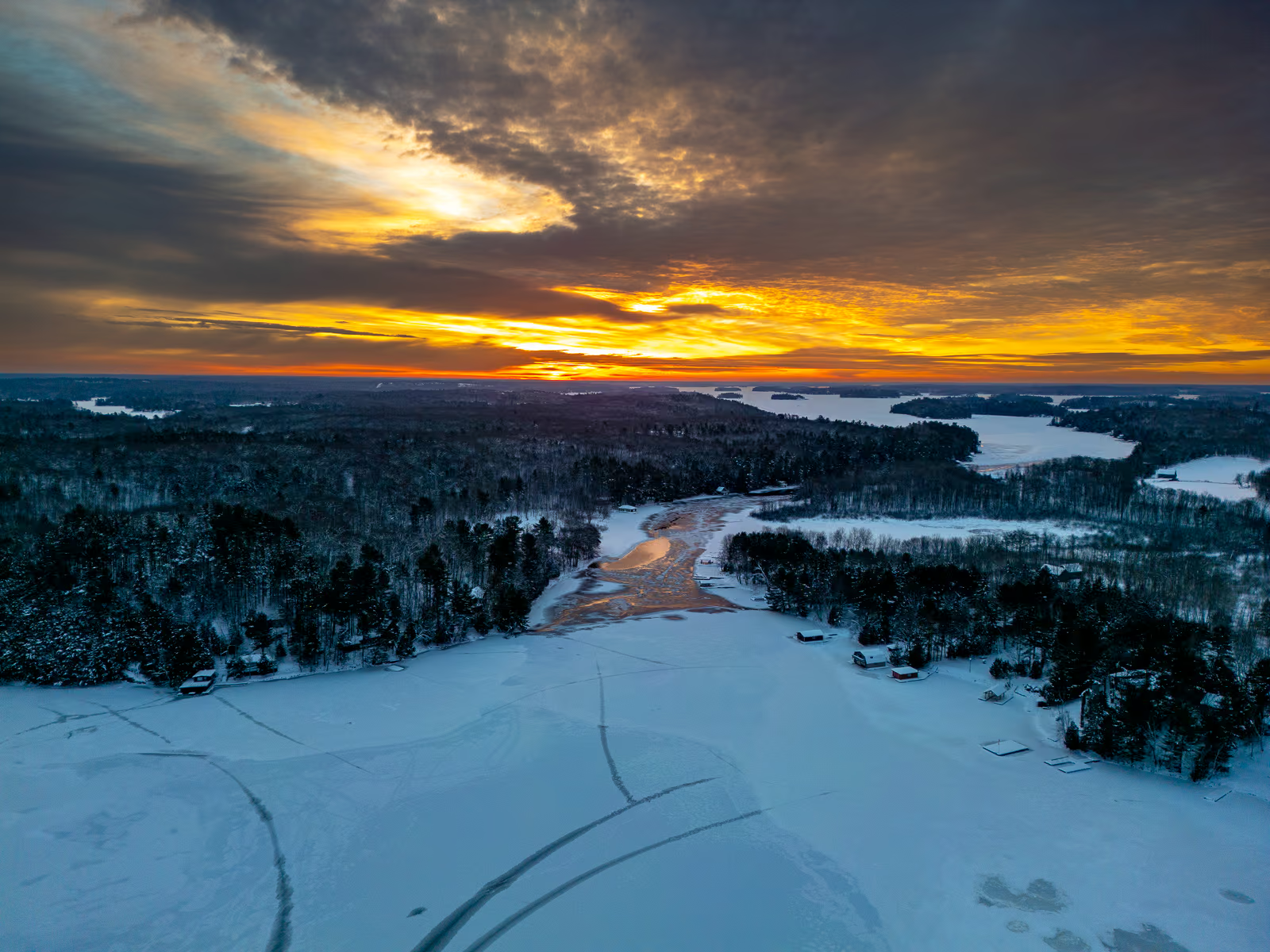
A bird’s-eye view of the “lid” on our lakes. As Dr. Sharma notes, the reliability of this ice is changing faster than ever.
Some environmental changes creep in quietly. Lake ice doesn’t.
In Episode 1 of How Lakes Work, Dr. Sapna Sharma (York University) laid out a reality that’s both simple and unsettling: winter is still here – but the rules that made ice predictable are breaking down.
This isn’t just about skating season or whether the bay freezes by Christmas. Ice connects to community traditions, remote supply routes, ecosystem health, and public safety. And right now, that connection is flashing like a warning light.
What you’ll take away from this post
- Why ice records are some of the longest climate datasets we have
- What “the disappearing signal” means – and why it’s accelerating
- The difference between black ice and white ice, and why it changes risk
- How less ice can ripple into evaporation, algae, and water quality
- Why road salt can change what happens under the ice
- What communities can do that’s practical and measurable
1) Ice isn’t just winter. It’s culture and infrastructure.
Sharma started with something easy to relate to: ice is woven into daily life across the Northern Hemisphere through recreation (hello, ice hockey) and through necessity (ice roads for food, fuel, supplies, and social connection in many remote communities).
Because ice mattered long before modern science did, people tracked it long before weather stations existed.
One of the most striking examples is Lake Suwa in Japan, where priests have recorded winter conditions for centuries – tied to the legend of a god crossing the frozen lake with a dragon, leaving a ridgeline “footsteps” event called the Omiwatari. The story is vivid, but the data behind it is even more powerful: it shows change in a way you can’t shrug off.
Punchline: Ice has always been watched closely because it mattered. That same long attention span now makes ice one of the clearest signals of climate disruption.
2) The “disappearing signal”: lakes are failing to freeze – and the pace is speeding up
Lake Suwa used to be consistent. Now it’s not.
In the last 50-year period discussed, it didn’t freeze 1 out of every 5 years. Since 1988, it hasn’t frozen 8 out of every 10 years. Sharma called this what it is: a disappearing signal – something that used to reliably appear, now fading out.
And it’s not just one lake.
Sharma described updates to massive datasets covering thousands of lakes. When the team extended earlier work to include recent decades, the graphs showed a steep decline after 1995.
Across the full time series, the change works out to roughly 18 fewer ice days per century – but when they broke it into 25-year chunks, the recent period stood out: the rate of ice loss was six times faster in the past 25 years than earlier periods.
Punchline: This isn’t “a little less ice.” It’s faster loss now, and the recent acceleration is the point.
3) Emissions scenarios aren’t abstract – small reductions change the outcome
One of the most practical parts of the talk: the future isn’t one fixed path.
Using warming scenarios aligned with IPCC frameworks, Sharma described projections showing that up to 215,000 lakes may no longer reliably freeze every winter under continued warming.
Then she went further: permanent ice loss by end-of-century under high emissions – on the order of ~5,700 lakes projected to become permanently ice-free.
But here’s the hinge: with even small reductions in greenhouse gas emissions, the projection dropped dramatically – down to ~429 lakes expected to become permanently ice-free (with the caveat that some deep lakes that already transitioned likely won’t revert).
Punchline: “What we choose” shows up directly on the ice. Even modest emissions cuts prevent a huge amount of permanent loss.
4) Ice quality is changing – and that’s where safety assumptions break
Most people talk about ice like it’s one thing: “Is it frozen?” or “How thick is it?”
Sharma focused on something more subtle and more dangerous: what the ice is made of.
She described a project measuring the ratio of black ice (clear ice) to white ice. In measurements taken in places like Lake Wilcox (Toronto area) and lakes in Sweden, cores were found that were 100% white ice.
Why does that matter?
Because when an ice core is entirely white ice, it can have about half the load-bearing strength of black ice—even if it looks solid and even if it’s “thick enough” by old rules of thumb.
Black ice vs white ice (example)
| Ice type | Example thickness | Allowable load (example) |
|---|---|---|
| 100% black ice | 10 centimetres (4 inches) | about 1,200 kilograms |
| White-ice core | 10 centimetres (4 inches) | only 120 kilograms |
So what conditions make white ice more likely?
Sharma gave a clear set of drivers:
- Temperatures hovering and oscillating around 0°C
- Melting of black ice at the surface
- Snowfall that later melts and refreezes into white ice
- Rain-on-ice events in winter (rain landing on the lake surface)
This is exactly the kind of winter many communities are seeing more often: not consistently cold, but variable – freeze-thaw, wet snow, rain, refreeze.
Punchline: Ice safety isn’t just thickness anymore. Under today’s winters, composition can change the strength of the ice dramatically.
If the shifting ice from a ‘white ice year’ like 2026 ends up tweaking your shoreline structures, be careful before you start swinging a hammer. A seemingly simple dock repair can turn into a $50,000 problem once the Township and environmental setbacks get involved.
5) Ice is a “lid” on the lake – and lifting it early reshapes the whole year
Sharma offered a metaphor that sticks because it’s accurate: ice is a lid on a lake in winter.
When that lid forms late or lifts early:
- Evaporation can increase
- Freshwater availability can decrease
- Earlier ice breakup is associated with more algal production and even toxic algal blooms in summer
- Water quality impacts can scale up to drinking-water concerns (she referenced the Great Lakes region supporting water needs for ~30 million people in its watershed)
Even if your lake still freezes, the timing and the light conditions under ice can shift the entire under-ice ecosystem – affecting oxygen, algae, and food-web activity.
Punchline: Ice is not a winter-only topic. It’s a switch that influences water quality and ecology long after the snow melts.
6) The invisible stressor: road salt can rewire under-ice conditions
One of the most “wait, what?” moments came from a small-lake example: Paint Lake near the Dorset Environmental Science Centre.
Sharma described finding surprising under-ice conditions – bottom water temperatures around 6°C (when you’d expect colder than 4°C at depth in typical winter structure) and bottom oxygen levels below 1 mg/L.
What explained it?
Conductivity measurements pointed to ions – specifically sodium and chloride – linked to road-salt inputs. The lake’s east basin had a salted highway running nearby.
She also noted that in a colder winter – when more road salt was presumably applied – the basin didn’t mix through spring and summer the way it typically does.
Punchline: Even “low” road-salt inputs can have outsized impacts under the ice – changing chemistry, oxygen, and seasonal mixing behavior.
7) Warmer winters predict higher drowning risk – and policy changes outcomes
Sharma described building a long-term dataset of winter drownings across lakes (using official records and standardized coding to make data comparable).
The result was stark: about 50% of the variation in winter drownings could be explained by winter air temperature. As winter air temperatures rose, drowning risk increased.
She also highlighted that outcomes aren’t just weather-driven:
- Some places (like Japan, in her example) have strong enforcement about when people can access ice
- Other regions face higher exposure because ice is tied to livelihood and travel, not just recreation
Punchline: Risk increases in warmer winters – but rules, enforcement, and exposure patterns can reduce harm.
What this means for lake people (and lake ice safety)
If you live on (or love) a lake, here’s the honest takeaway:
- The winter you remember – steady cold, predictable freeze-up – cannot be assumed going forward.
- “Looks fine to me” is getting less reliable, especially with more freeze-thaw and rain-on-ice patterns.
- The impacts don’t stop at shoreline season: ice changes can echo into algae, oxygen, and water quality.
- Local stressors like road salt can amplify the shift in ways most people don’t see.
Practical actions that actually map to the science
- Track and share observations: ice-on, ice-off, snow depth on ice, mid-winter rain events (community science matters)
- Treat safety guidance as dynamic: follow local advisories; don’t rely on old heuristics
- Reduce road-salt loading: smarter application, better storage, alternatives where appropriate
- Support mitigation: the projections make it clear – emissions pathways change lake outcomes
FAQ
What’s the difference between black ice and white ice?
Black ice (clear ice) forms during cold, still conditions and is generally stronger. White ice often forms through melt/refreeze processes (and snow/rain influence) and can have substantially lower load-bearing strength.
Why are lakes losing ice faster after the mid-1990s?
Updated long-term records show a steep decline after 1995, consistent with warming air temperatures driven by increased greenhouse gases.
How can less ice lead to more algae in summer?
Earlier ice breakup changes the timing of light, warming, and mixing – conditions linked to higher algal production and, in some cases, toxic blooms.
Can road salt really affect a lake in winter?
Yes. Under-ice conductivity and ion shifts (sodium/chloride) can change water chemistry and oxygen dynamics, with knock-on effects for seasonal mixing.
Is ice ever “safe”?
No ice is 100% safe. Under today’s variable winters, the risk is less predictable – especially when ice quality shifts toward white ice.
Leave a Reply